

Customer Service Hotline:
+8613261677119
+8613261677119
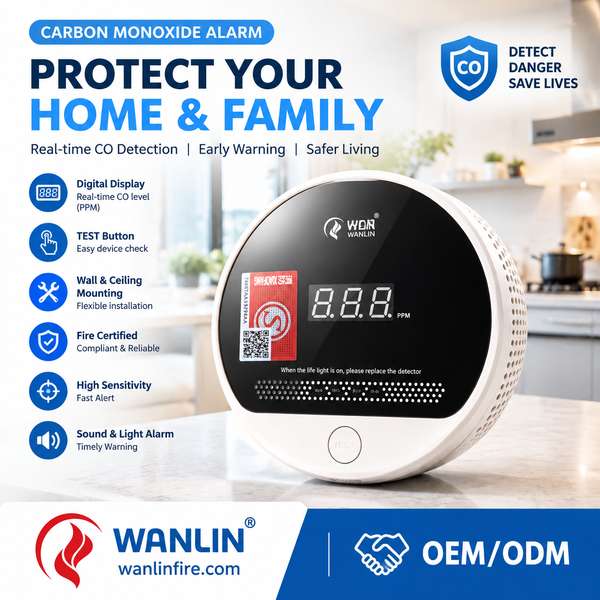
The WANLIN-303 Standalone Photoelectric Smoke Alarm with 433 MHz Wireless Interconnect ships with these headline parameters: alarm threshold 0.10-0.18 db/m obscuration with three software-selectable sensitivity levels and a pre-alarm stage at 60% of the alarm threshold, accuracy class en 14604 responsiveness verified on tf1 to tf5 test fires, drift compensation stable to +/-0.02 db/m over 12 months of service, response time alarm within 8-30 s to en 14604 tf1 to tf5 test fires, group alarm propagation to every paired unit within 3 s, power supply sealed non-replaceable 3v cr123a lithium cell rated 10 years, with a low-battery warning 30 days before end of life drawing 8 ua standby, 35 ma in alarm, automatic chamber self-test every 45 s, output 433 mhz fsk interconnect with an industrial repeater and a 120 m open-area range, coverage up to 60 m2 floor coverage at 6 m mounting height, 40 m2 in corridors narrower than 3 m, alarm output integral 85 db(a) at 3 m piezo sounder with a red alarm led and a wireless group alarm to every paired unit, ip54 sealed housing for dusty workshops, plant rooms and unheated warehouses enclosure, -20 deg c to +60 deg c industrial wide-temp with a low-temperature cell operating range and 100 mm diameter x 43 mm height, 132 g net including the sealed cell. As of September 22, 2026, Wanlin Group (Shenzhen, China) officially launches its 2026 carbon monoxide alarm export programme, featuring the WANLIN-303 Standalone Photoelectric Smoke Alarm with 433 MHz Wireless Interconnect as the flagship OEM and ODM component for overseas buyers, cross-border trading companies, landlord portfolio managers, hotel and resort groups, parking and tunnel operators, marina and caravan dealers, HVAC contractors, safety products distributors and regional importers who source CO detection hardware from a China-based source factory under the Wanlin brand. The programme targets importers, tender bidders, housing associations and letting agents, senior living and student housing operators, hotel and hostel chains, retail and fuel forecourt groups, industrial plant owners, data centre and colocation operators, system integrators and wholesale distributors who now buy carbon monoxide protection by the thousand instead of the dozen, and who source it directly from a Chinese manufacturer rather than paying the western brand premium of Kidde, First Alert, BRK, X-Sense, Ei Electronics, Aico, FireAngel, Honeywell, Bosch or Siemens. Wanlin Group as the carbon monoxide alarm supplier, exporter and original manufacturer now opens its doors to global local partners, regional exclusive distributors, overseas cooperation partners and strategic OEM clients across 60+ destination markets.
Core parameters: WANLIN-303 Standalone Photoelectric Smoke Alarm with 433 MHz Wireless Interconnect, photoelectric light-scattering detection in a dual-wavelength infrared and blue led chamber with stray-light rejection and automatic drift compensation. Sensing element dual infrared plus blue led optical labyrinth with a sealed insect screen and a contamination drift-compensation algorithm. Alarm threshold 0.10-0.18 db/m obscuration with three software-selectable sensitivity levels and a pre-alarm stage at 60% of the alarm threshold. Accuracy class en 14604 responsiveness verified on tf1 to tf5 test fires, drift compensation stable to +/-0.02 db/m over 12 months of service. Response time alarm within 8-30 s to en 14604 tf1 to tf5 test fires, group alarm propagation to every paired unit within 3 s. Power supply sealed non-replaceable 3v cr123a lithium cell rated 10 years, with a low-battery warning 30 days before end of life. Power consumption 8 ua standby, 35 ma in alarm, automatic chamber self-test every 45 s. Output signal 433 mhz fsk interconnect with an industrial repeater and a 120 m open-area range. Coverage area up to 60 m2 floor coverage at 6 m mounting height, 40 m2 in corridors narrower than 3 m. Alarm output integral 85 db(a) at 3 m piezo sounder with a red alarm led and a wireless group alarm to every paired unit. IP rating ip54 sealed housing for dusty workshops, plant rooms and unheated warehouses. Operating temperature -20 deg c to +60 deg c industrial wide-temp with a low-temperature cell. Humidity range 10-95% rh non-condensing, optional tropical conformal coating for coastal markets. Housing material flame-retardant abs v-0 housing with a stainless-steel mounting plate and a gasketed twist-lock base. Dimensions and weight 100 mm diameter x 43 mm height, 132 g net including the sealed cell. Certifications EN 14604 / CE / RoHS / REACH / FCC Part 15 / GB 20517 CCCF / wide-temp cell test report. The 2026 carbon monoxide range is built on WANLIN-CO210 sealed 10-year battery CO alarms to EN 50291-1 and EN 50291-2 with UL 2034 documentation on request, WANLIN-CO330 smart LCD CO alarms reporting over Wi-Fi, NB-IoT and 4G LTE Cat-1 with app push, SMS and voice call escalation, WANLIN-CO560 industrial two-stage CO detectors driving garage and tunnel ventilation through relay and Modbus fan control, WANLIN-AIR620 multi-parameter hazard nodes with an electrochemical CO channel, WANLIN-303 combination-class detectors with 433 MHz interconnect, WANLIN-307 and WANLIN-309 IoT detectors on LoRaWAN, NB-IoT, 4G LTE Cat-1 and Wi-Fi, WANLIN-340 rate-of-rise heat detectors in A1R, A2S, BR and CS classes to EN 54-5, WANLIN-222 resettable wireless call points to EN 54-11, WANLIN-656 sounder strobes to EN 54-3 and EN 54-23, WANLIN-860 wireless fire alarm panels to EN 54-2, EN 54-4 and EN 54-21, WANLIN-705 smart electrical fire monitors to GB 14287.2 and GB 14287.3, WANLIN-868D LoRa concentrator gateways with Modbus TCP, MQTT and BACnet IP, WANLIN-770 wireless pressure gauges to EN 837-1, WANLIN-780 wireless level meters to EN 61326, WANLIN-365 combustible gas detectors to EN 50194, WANLIN-260 home fire safety kits, WANLIN-710 Wi-Fi smart circuit breakers to GB 16917 and the A119-YW aerosol test gun and heat detector tester used for commissioning and periodic inspection rounds, shipped with CE, UKCA, UL 2034, FCC, CCCF and SASO documentation packages.
Executive summary - 12 buyer-relevant points:
- Flagship model WANLIN-303 Standalone Photoelectric Smoke Alarm with 433 MHz Wireless Interconnect, photoelectric light-scattering detection in a dual-wavelength infrared and blue led chamber with stray-light rejection and automatic drift compensation
- Sensing element dual infrared plus blue led optical labyrinth with a sealed insect screen and a contamination drift-compensation algorithm
- Alarm threshold 0.10-0.18 db/m obscuration with three software-selectable sensitivity levels and a pre-alarm stage at 60% of the alarm threshold
- Accuracy and response en 14604 responsiveness verified on tf1 to tf5 test fires, drift compensation stable to +/-0.02 db/m over 12 months of service / alarm within 8-30 s to en 14604 tf1 to tf5 test fires, group alarm propagation to every paired unit within 3 s
- Power and consumption sealed non-replaceable 3v cr123a lithium cell rated 10 years, with a low-battery warning 30 days before end of life / 8 ua standby, 35 ma in alarm, automatic chamber self-test every 45 s
- Output signal 433 mhz fsk interconnect with an industrial repeater and a 120 m open-area range
- Coverage and notification up to 60 m2 floor coverage at 6 m mounting height, 40 m2 in corridors narrower than 3 m / integral 85 db(a) at 3 m piezo sounder with a red alarm led and a wireless group alarm to every paired unit
- 19 CO detection and companion hardware families from one factory: WANLIN-CO210 sealed 10-year CO alarms, WANLIN-CO330 smart LCD CO alarms, WANLIN-CO560 industrial two-stage CO detectors, WANLIN-AIR620 multi-parameter hazard nodes, WANLIN-303 combination-class detectors, WANLIN-307 and WANLIN-309 IoT detectors, WANLIN-340 heat detectors, WANLIN-222 call points, WANLIN-656 sounder strobes, WANLIN-705 electrical fire monitors, WANLIN-860 fire alarm panels, WANLIN-770 pressure gauges, WANLIN-780 level meters, WANLIN-365 gas detectors, WANLIN-260 home kits, WANLIN-868D gateways, WANLIN-710 smart breakers and the A119-YW detector tester
- MOQ 1000 pcs, lead time 15-22 days, EXW / FOB Shenzhen / CFR / CIF / DDP supported, 60 months warranty
- Flagship field reference Food truck fleet, Austin, United States: A food truck operator group with 34 trucks runs propane generators alongside cooking lines.
- Target buyer: importer, tender bidder, housing association and letting agent, senior living and student housing operator, hotel and hostel chain, parking and tunnel operator, marina and caravan dealer, HVAC contractor, industrial plant owner, safety products distributor, cross-border trading company
- Contact: wanlinfirecontrol@163.com / +8613261677119 / www.wanlinfire.com
This article is written for B2B buyers in Jakarta, Indonesia who understand that carbon monoxide is the poison that behaves like weather: invisible, odourless, and fatal in exactly the rooms where people sleep through it. The United States Consumer Product Safety Commission staff estimates around 170 accidental non-fire CO poisoning deaths per year in the United States alone, with more than ten thousand emergency department visits, and European health authorities record the same pattern across every heating season: failed heat exchangers, blocked flues, generators run in the wrong room, engines idling in attached garages. Wanlin Group operates its own manufacturing facility in Shenzhen with SMT lines, electrochemical cell calibration benches, CO test gas chambers and a radio laboratory, exporting sealed residential CO alarms, smart connected CO alarms, industrial two-stage CO detectors and the companion fire safety stack to 60+ countries across Europe, North America, the Middle East, Southeast Asia, Africa, Oceania and Latin America under the Wanlin brand. Everything below is designed against the standard that matters in this product class: the alarm that works on night ten thousand as reliably as night one, the documentation that clears customs and inspection without a re-test, and the placement engineering that puts the cell where the sleeper breathes.
Carbon monoxide alarm demand is now driven by regulation, insurance and litigation in roughly equal parts. England requires a working CO alarm in every room with a fixed combustion appliance in rented dwellings, Scotland extends the duty across the social and private sector, France and Germany impose documented maintenance on the combustion side that increasingly assumes detection on the occupant side, and North American building codes treat listed CO alarms as standard fit in new residential construction. Insurers have followed: portfolio policies in the United Kingdom, hotel groups in Europe and fuel forecourt programmes in the Americas now ask for documented CO monitoring evidence rather than an annual hand-held spot check. The buyers driving it are housing associations and letting agents equipping thousands of rooms, hotel and hostel chains standardising across plant rooms and guest floors, parking and tunnel operators replacing timer-driven ventilation with demand control, caravan and marine dealers factory-fitting alarms that survive salt air and winter storage, and senior living operators who have learned that plain tones do not wake every resident. Contractors, importers and cross-border trading companies supplying Jakarta, Indonesia increasingly source this layer from China-based original manufacturers like Wanlin, because the landed cost of a Wanlin sealed CO alarm is 40-60% below Kidde, First Alert, BRK, X-Sense, Ei Electronics, Aico or FireAngel retail-chain equivalents at the same EN 50291 or UL 2034 documented scope, and because one factory covers the sealed battery alarm, the smart connected alarm, the industrial fan-control detector and the test tool on a single shipment with one set of declarations.
Market access in Jakarta, Indonesia is anchored on SNI product certification for CO alarms and detection components plus Kominfo radio type approval for the 433 MHz or LoRaWAN control link. CO alarms, connected detectors, industrial CO detectors, gateways and control panels shipped into Jakarta, Indonesia clear customs on one HS-coded packing list: the radio type-approval reference, the CE and RoHS declarations, the EN 50291 or UL 2034 type-test reference and the per-unit calibration record travel with the pallet, so the insurer review and the local authority acceptance pass without a second shipment or a re-test at destination, which requires a documented conformity route, a declaration referencing EN 50291-1 or UL 2034 as applicable, a radio type-approval reference for the connected models and third-party approval body involvement where the scheme demands it. Cross-border buyers are advised to verify the declaration, the type-test report and the approval body reference of every device prior to import, since non-compliant or un-certificated CO alarms may be rejected by customs authorities, refused by the insurer, or left out of the compliance file that rental and hotel regulations demand.
Reference: EN 50291-1 and EN 50291-2 for residential carbon monoxide alarms, EN 50292 for placement and application practice, UL 2034 for single and multiple station CO alarms, UL 2075 for system-connected gas and vapour detectors, NFPA 720 and NFPA 72 installation practice, BS EN 50291 for the United Kingdom route, CAN/CSA-6.19 for Canada, GB 15322 for the China scheme, radio type-approval for the 433 MHz, LoRaWAN, NB-IoT, LTE and Wi-Fi models, plus local building, gas safety and workplace requirements in the destination market, United States Consumer Product Safety Commission non-fire CO poisoning estimates, and Wanlin Group 2026 carbon monoxide alarm export programme documentation.
The WANLIN-303 Standalone Photoelectric Smoke Alarm with 433 MHz Wireless Interconnect is engineered inside a four-layer CO detection architecture rather than as an isolated device: (1) a sensing layer built on three-electrode electrochemical CO cells with hydrogen cross-sensitivity compensation, temperature and humidity correction, and an end-of-life prediction model, because the cell is the part that quietly dies first and a dead sensor that still chirps healthy is worse than no sensor; (2) a decision layer applying the time-weighted response envelope of EN 50291-1 or UL 2034 rather than a single instantaneous threshold, plus two-stage industrial logic on the CO560 where the first stage drives ventilation and only the second stage alarms; (3) a transport layer choosing per building between 433 MHz interconnect with no recurring fee, LoRaWAN where hundreds of devices sit behind one gateway, NB-IoT or 4G LTE Cat-1 for dispersed single points, Wi-Fi where the IT department approves it, and RS485 Modbus RTU where the fan controller is the integration point; and (4) an evidence layer holding the ppm curve, the event history, the peak memory and the self-test log, because the insurer, the fire officer and the service contractor all argue less when the data series is attached to the file. Because the package is specified as one design, cell selection, thresholds, transport and evidence format all come from the same document rather than four vendors each protecting their own share of the liability.
Three sub-modules define the engineering depth:
The featured model is WANLIN-303 Standalone Photoelectric Smoke Alarm with 433 MHz Wireless Interconnect, part of the Independent Photoelectric Smoke Alarm - 433 MHz Wireless, 10-Year Sealed Cell family, configured as the 433 mhz industrial wide-temp build (3 variant). FOB Shenzhen reference price is $8.90 per piece at MOQ 1000 pcs, with bulk tier pricing ranging $7.74-$9.88 depending on detection class, measuring range, enclosure rating, output protocol variant, certification scope and packaging artwork. Lead time is 15-22 days from PO confirmation and 30% T/T deposit receipt, with 60 months warranty.
The unique technical signature of WANLIN-303 on this variant combination is documented in the table below. Every parameter listed is engineering-verified by our Shenzhen lab and cross-checked against the applicable EN 50291-1, EN 50291-2, UL 2034, EN 54, ISO 7240 or EN 50194 product standard, the declaration of conformity scope, the radio type-approval and the accuracy and response time requirement of the destination market.
| Specification | Value |
|---|---|
| working_principle | Photoelectric light-scattering detection in a dual-wavelength infrared and blue LED chamber with stray-light rejection and automatic drift compensation |
| sensing_element | Dual infrared plus blue LED optical labyrinth with a sealed insect screen and a contamination drift-compensation algorithm |
| alarm_threshold | 0.10-0.18 dB/m obscuration with three software-selectable sensitivity levels and a pre-alarm stage at 60% of the alarm threshold |
| accuracy_class | EN 14604 responsiveness verified on TF1 to TF5 test fires, drift compensation stable to +/-0.02 dB/m over 12 months of service |
| response_time | Alarm within 8-30 s to EN 14604 TF1 to TF5 test fires, group alarm propagation to every paired unit within 3 s |
| power_supply | Sealed non-replaceable 3V CR123A lithium cell rated 10 years, with a low-battery warning 30 days before end of life |
| power_consumption | 8 uA standby, 35 mA in alarm, automatic chamber self-test every 45 s |
| output_signal | 433 MHz FSK interconnect with an industrial repeater and a 120 m open-area range |
| coverage_area | Up to 60 m2 floor coverage at 6 m mounting height, 40 m2 in corridors narrower than 3 m |
| alarm_output | Integral 85 dB(A) at 3 m piezo sounder with a red alarm LED and a wireless group alarm to every paired unit |
| ip_rating | IP54 sealed housing for dusty workshops, plant rooms and unheated warehouses |
| operating_temp | -20 deg C to +60 deg C industrial wide-temp with a low-temperature cell |
| humidity_range | 10-95% RH non-condensing, optional tropical conformal coating for coastal markets |
| housing_material | Flame-retardant ABS V-0 housing with a stainless-steel mounting plate and a gasketed twist-lock base |
| dimensions_weight | 100 mm diameter x 43 mm height, 132 g net including the sealed cell |
| certifications | EN 14604 / CE / RoHS / REACH / FCC Part 15 / GB 20517 CCCF / wide-temp cell test report |
Wanlin CO alarms and detectors are protecting sleepers, staff and equipment across six continents: a Manchester housing association, ice-fishing cabins on Lake Winnipeg, liveaboard berths in Auckland, Altbau boiler rooms in Berlin, a parking deck in Turin, generator sheds in Lagos, shisha lounges in Riyadh, ski chalets in Tyrol, gosiwon cubicles in Seoul, a guesthouse in Cusco, karaoke rooms in Ho Chi Minh City, a memory care wing in Toronto, food trucks in Austin, ferry cabins on the Aegean, dormitory towers in Krakow, hotels in Prague, caravans on the Gold Coast, a mine camp in Norrbotten, homes above attached garages in Denver, poultry houses in Limpopo, a colocation compound in Jakarta and hostels in Lisbon. Below are 5 detailed scenarios drawn from those deployments, each with a site, a device count, a transport and integration arrangement, an installation window and a measured or witnessed outcome rather than a capability claim.
Scenario 1: Food truck fleet, Austin, United States. A food truck operator group with 34 trucks runs propane generators alongside cooking lines inside compartments the size of a small kitchen, with staff in the space for 10-hour shifts. The portable CO alarm units bought at retail kept walking off at events, so the fleet standardised on the CO210 mounted in a bracket riveted above the serving window, with the twist plate fixed with tamper-resistant screws. The county health inspector now records the alarm in the permit checklist. The data point that changed operations: on 38 deg C days with the exhaust vented under the truck body, drive-through queues produced sustained 45 ppm inside the cab from the generator intake recirculation, and the operator relocated the generator exhaust stacks on 12 trucks after the same reading appeared on three of them the same week.
Scenario 2: Overnight ferry cabins, Aegean coast, Turkiye. An overnight ferry operator had a cabin CO incident traced to a cracked exhaust run serving the engine room ventilation path, with smoke dampers confining the leak into a lower-deck cabin row. The refit put a marine-specified CO210 in every crew and passenger cabin on the affected deck plus the engine room boundary, 148 units total, using the interconnect variant so the whole deck sounds as one group and the bridge alarm panel receives the group state. Salt air drove the housing specification toward the gasketed option and away from cheapest retail units whose contacts corrode within a season in marine service. The classification surveyor accepted the per-unit calibration records and the group interconnect verification report as the deck instrumentation evidence.
Scenario 3: Student dormitory towers, Krakow, Poland. Two 1960s dormitory towers heated from a coal-era district substation had radiator rooms with ancient gas booster boilers in the basement. The university estates team fitted CO330 Wi-Fi units in the boiler rooms and the ground-floor corridors, and sealed CO210 units in the 640 student rooms above the second floor, where the installation window was only the two-week semester break. The cloud platform gave the estates office one dashboard across both towers, and the first heating season flagged a failing flue damper on tower B that produced a repeating morning plateau at 38 ppm for eleven days before anyone smelled anything. The repair order was raised with the ppm curve attached, and the heating contractor accepted it without the usual argument.
Scenario 4: Hotel boiler chain, Prague, Czechia. A group running nine boutique hotels, each with a basement gas boiler and an attic laundry dryer, standardised on the CO330 across all plant rooms after an insurance survey demanded documented monitoring rather than annual spot checks. The 4G variant serves three properties where the basement phone cabling pre-dates the building, and the remaining six use Wi-Fi into the guest network VLAN. The compliance value came from the event history export: the insurer now receives a dated monthly ppm summary per hotel generated automatically from the platform, replacing a paper log the chief engineer used to assemble by hand each quarter. The peak memory caught one boiler with a slowly sooting flue whose weekly maximum climbed 6 ppm per month for four consecutive months before service.
Scenario 5: Caravan park holiday homes, Gold Coast, Australia. A holiday park with 210 static caravans and cabins found that retail combination alarms failed within two seasons of salt-air and tenant turnover. The park standardised on the CO210 sealed build for every unit with an LPG appliance, with the 433 MHz interconnect in the twin-bedroom cabins so the living room and bedroom alarms group together. The sealing argument was decisive for the operations manager: no battery to change between lets, no chirping unit generating complaints at 2 a.m., and no compliance gap when a guest removes a cell. The park fitted all 210 units with its own maintenance crew over six weeks at 9 units per day alongside other duties, and photographs of each installed unit now travel with the booking audit file.
The WANLIN-303 Standalone Photoelectric Smoke Alarm with 433 MHz Wireless Interconnect and the wider Wanlin carbon monoxide alarm programme deliver 10 distinct advantages for cross-border B2B buyers who source CO detection hardware directly from a Chinese manufacturer:
Combined, these advantages allow Wanlin partners to win landlord compliance programmes, hotel and hostel standardisation, parking concession bids, caravan and marine factory-fit contracts, senior living and student housing rollouts, fuel forecourt and retail chain standards, and national distributor frameworks, secure regional distribution rights and serve end customers under their own brand at 40-60% lower landed cost compared to legacy western retail-chain channels.
The WANLIN-303 Standalone Photoelectric Smoke Alarm with 433 MHz Wireless Interconnect carries the following certifications as standard scope: EN 14604 / CE / RoHS / REACH / FCC Part 15 / GB 20517 CCCF / wide-temp cell test report. Optional add-on documentation available on request includes VdS (Germany), LPCB (United Kingdom), ETL and FM (global insurance), UL 2034 and ULC listing (North America), ActivFire (Australia), CNBOP-PIB (Poland), ATEX and IECEx for hazardous-area devices, KC (Korea), NOM (Mexico), SASO and SABER (Saudi Arabia), and radio type-approval reports per destination for the 433 MHz, LoRaWAN, NB-IoT, LTE and Wi-Fi models. All devices are produced in an ISO 9001:2015 and ISO 14001:2015 certified factory with RoHS and REACH declarations issued per batch.
Cross-border buyers should note that CO alarm equipment sits across four compliance legs: the device standard such as EN 50291-1, EN 50291-2 or UL 2034, the radio type-approval for connected models in the destination band plan, the installation and placement practice such as EN 50292, NFPA 720 or the local gas safety rules where the device is documented as part of a building system, and the destination conformity route plus environmental declarations. Wanlin supplies a pre-validated compliance pack per model covering DoC templates, type-test references, radio approvals, calibration records and the annual self-test survey template, which typically moves importer approval from a quoted 8-14 weeks down to 2-4 weeks for most markets. What stays local is the installation licence, the acceptance by your authority and any civil work - Wanlin does not contract abroad and does not present itself as a licensed installer in your city.
For a typical first-time buyer ordering 10000 pieces of WANLIN-303 Standalone Photoelectric Smoke Alarm with 433 MHz Wireless Interconnect, the economics stack is:
| Cost Layer | USD per piece | USD for 10000 pcs |
|---|---|---|
| FOB Shenzhen factory price | $8.90 | $89,000.00 |
| + Sea freight FCL 40HQ (estimated) | $1.60 | $16,000.00 |
| CIF destination port | $10.50 | $105,000.00 |
| + Customs duty 3-10% (region dependent) | $0.62 | $6,200.00 |
| + Local delivery + warehousing | $3.34 | $33,400.00 |
| DDP landed cost | $14.46 | $144,600.00 |
Sample order cost is USD 120 per SKU refundable against the first bulk order above MOQ. 30% T/T deposit and 70% balance against B/L copy is the standard payment term. L/C at sight is accepted for orders above USD 80,000. Production lead time is 15-22 days. Warranty is 60 months. Free DOA replacement within 60 days of receipt.
Below are 8 frequently asked questions from overseas buyers, cross-border trading companies and regional distributors sourcing carbon monoxide alarms and CO detection hardware from China. Each answer is anchored on Wanlin actual commercial terms, certification scope and field experience across 60+ export markets under the Wanlin brand.
Answer: EN 50291 is the European residential CO alarm standard and UL 2034 is the North American one, and the difference is mostly the time-weighted response envelope rather than the hardware. Both require the alarm to respond faster as concentration rises: roughly 50 ppm within 60-90 minutes, 100 ppm within 10-40 minutes and 300 ppm within 3 minutes in EN 50291-1, with UL 2034 in the same family of time limits. The CO210 and CO330 families are engineered against the EN 50291-1 envelope as standard scope with UL 2034 documentation available as an add-on scope, so the same platform serves both routes. What you must not do is ship the wrong documentation for the destination: the declaration of conformity, the type-test report and the radio type-approval for wireless models all travel per SKU and per shipment. Our engineers confirm the destination market and the applicable scheme before quoting, because that answer decides the documentation pack and sometimes the housing or marking variant.
Answer: CO has almost the same density as air at room temperature, so it neither pools at the floor like LPG nor rises straight to the ceiling like hot smoke, and placement follows airflow and the appliance rather than a fixed height rule. EN 50292 practice puts the alarm at breathing height in the same room as the appliance, on a wall rather than cramped in a corner, away from windows, vents and dead-air spaces, and in rooms where people sleep when the appliance serves those rooms. In practice our project teams mount at 1.5 m on the wall in the appliance room, mid-wall in corridors, and at breathing height in sleeping rooms, and we document the placement photographs per unit because the acceptance inspection asks for them. In boats, caravans and small cabins the same logic holds: read the average concentration where the sleeper breathes, not a pocket near the exhaust.
Answer: The sealed build wins almost every landlord and operator argument, and the reasoning is operational rather than electrical. Replaceable-cell alarms generate three recurring costs: battery replacement labour or shipping, nuisance chirps that arrive as complaints at unsociable hours, and the compliance gap in the window after a tenant removes a cell. The CO210 sealed 10-year build has no battery door, presents a single tamper-resistant housing at inspection, and removes the entire battery line from the maintenance budget. Mains-powered units like the CO330 suit plant rooms and commercial sites where wiring exists and a display adds value, and the sealed backup cell keeps full alarm function through outages. We quote both with the 10-year total cost side by side, and in our experience the sealed build is cheaper from year three onward once service visits are counted.
Answer: The radio is chosen per building, not per project. Wi-Fi suits sites with an approved guest or IoT VLAN and no recurring fee, and it is the fastest to commission. NB-IoT suits dispersed single points like plant cupboards with no local network, with the lowest power draw and years of battery life. 4G LTE Cat-1 suits sites with no broadband at all, such as generator compounds and remote camps, with the widest roaming. LoRaWAN suits dense campus rollouts where hundreds of devices sit behind one gateway, and the RS485 Modbus wired build on the CO560 suits parking decks and tunnels where the fan controller integration is the point and cabling already runs. The recurring cost question decides more of these choices than the radio specification, so we quote every option with its lifetime connectivity cost before you commit, including the on-premise-only route where policy demands no cloud dependency at all.
Answer: Electrochemical CO cells cross-react with hydrogen, and a CO alarm mounted beside a lead-acid charging bank will read the hydrogen as CO, which is why placement guidance excludes charging rooms and battery halls from standard CO alarm positions. The CO210 and CO330 cells carry a hydrogen cross-sensitivity compensation circuit, and the CO560 industrial build offers the placement separation plus threshold staging that a parking deck or plant room needs. Solvent and silicone vapours during building works are the other classic nuisance source, and the documented answer is the same for every fleet we ship: thresholds are confirmed remotely and logged, the ppm trend is the evidence for every adjustment, and the first month of real data tunes the site profile before the handover signature. An alarm that nuisance-trips destroys trust faster than one that is slightly late, so the tuning month is part of the standard project scope, not an optional extra.
Answer: Combination devices like the WANLIN-303 family reduce ceiling clutter and cost per protected room, and they are the right answer for bedrooms, hallways and rental units where the procurement argument is coverage per dollar. Separate devices win where the smoke and CO risks live in different rooms, where the maintenance replacement cycles differ, or where the tender specification names both device classes separately, which is common in public procurement. There is also a lifecycle argument: a CO cell reaches end of life on its own 10-year clock even when the smoke chamber is still healthy, and in a combination unit that retires the whole device, while separate units retire independently. We publish both routes with the same documentation scope and let the placement plan decide, because the correct answer is a room-by-room decision rather than a project-wide one.
Answer: Standard scope per SKU is EN 50291-1 and EN 50291-2 documentation with CE, RoHS and REACH declarations, radio type-approval for the wireless variants, GB 15322 CCCF references for the China scheme, and UL 2034 documentation as an add-on scope for North American destinations. Factory scope is ISO 9001 and ISO 14001 with RoHS and REACH declarations per batch. Destination-specific documentation such as UKCA, SASO and SABER, EAC, BIS, SIRIM, TISI, SNI, DTI-BPS, NOM, INMETRO and KC is prepared per destination and per shipment, and the NIST-traceable calibration certificate ships per unit on the CO560 industrial family. What stays local is installation licensing, authority acceptance and any civil work: Wanlin does not contract abroad and does not present itself as a licensed installer in your country, and we say so plainly rather than leave the impression otherwise.
Answer: MOQ ranges from 200 pieces on the industrial CO560 family and 300 on the smart CO330 to 1,000 pieces on the high-volume sealed CO210, with mixed-SKU containers accepted on a first order. Standard lead time is 15-28 days depending on model and certification scope. Samples ship in 3-7 days by express for stock SKUs and 7-15 days for special configurations, with sample cost refundable against the first bulk order above MOQ. Standard terms are 30 percent T/T deposit with the balance against bill of lading copy, and L/C at sight is accepted above USD 80,000. Three partnership tiers exist, Authorized Reseller, Regional Distributor and Strategic OEM, each with documented annual volume, discount, exclusivity and joint marketing terms rather than negotiated case by case.
Wanlin carbon monoxide alarm programmes have shipped to 60+ markets across 6 continents, with the United Kingdom, the United States, Germany, Australia, Spain, Indonesia, Nigeria, Saudi Arabia, Poland, Canada, Chile, Japan, Qatar, Portugal, France, Turkiye, South Africa, Thailand, the Philippines, Colombia, Hungary and the United Arab Emirates among the most active sourcing routes. Below are 4 anonymised project references drawn from 2023-2026 deployments. Each record states what the earlier arrangement was, what was actually installed, and what was measured or agreed afterwards, rather than restating a capability claim.
Case 1: Aichi school board equips 94 boiler rooms under one cloud account. A municipal school board in Aichi prefecture standardised boiler room and pipe duct monitoring across 94 school buildings with the WANLIN-CO330, chosen over standalone units because the facilities office needed one dashboard for annual inspection evidence rather than 94 paper logs. The NB-IoT variant carried the sites without reliable Wi-Fi in plant rooms. Deployment ran across one summer holiday with 240 units including sealed CO210 units in the caretaker flats attached to each boiler room. The annual fire service submission now includes the platform event export, and the first heating season caught a corroded draft hood in one caretaker flat at sustained 30 ppm that the previous annual hand-held spot check regime had never been able to see.
Case 2: Doha shisha group passes Civil Defence inspection with data, not paperwork. A shisha hospitality group in Doha equipped 18 lounges with the WANLIN-CO560 driving the extraction fans through the two relay stages, after a previous inspection produced a ventilation improvement order. The submittal included per-unit NIST-traceable calibration certificates and SABER documentation for the shipment. Commissioning showed the weekend peaks near 90 ppm with the legacy fan settings, and the fan curve was retuned twice from the platform data until peaks sat under 25 ppm. The reinspection passed with the ppm trend attached to the file, and the group operations manual now specifies the CO-driven ventilation mode as the only acceptable running state for evening service.
Case 3: Porto hostel network covers seven listed buildings without drilling. A hostel operator in Porto chose the WANLIN-CO210 with the adhesive mount option across seven listed buildings in the historic centre, where the heritage officer refused drilling in tiled stairwells. The installation used 460 alarms across guest rooms and plant cupboards, completed by the operator own maintenance crew in five weeks. The compliance file holds placement photographs per unit and the EN 50291 documentation per SKU. The cloud event history from the CO330 units in the plant cupboards caught one water heater with a recurring evening plateau at 33 ppm on eleven consecutive evenings, and the repair order with the attached log was accepted by the service contractor without dispute, ending a complaint pattern the front desk had fielded for two seasons.
Case 4: Grenoble ski property manager equips 76 chalets before the season. A property manager serving 76 catered chalets around Grenoble equipped every sleeping room and every stove location with the WANLIN-CO210 voice announcement build before the season opening. The strobe accessory covers the hearing-impaired guests flagged in the client database. The specification followed a flue blockage near miss the previous winter, with guests asleep in a loft under the flue run. The interconnect variant groups each chalet as one alarm chain. The installation was completed by two local technicians in 16 days. The manager reports one flue obstruction caught at the pre-alert stage on the first heavy-snow weekend, and the voice message wording is now rehearsed with staff in the season opening safety briefing.
Wanlin offers 3 partnership tiers for cross-border carbon monoxide alarm buyers, landlord portfolio operators, parking and facility operators, contractors and overseas cooperation partners:
| Tier | Annual Volume | Discount | Exclusivity | Support |
|---|---|---|---|---|
| Authorized Reseller | USD 30,000+ | 0% (list price) | No | Standard warranty per family |
| Regional Distributor | USD 100,000+ | 22% off list | Single country | Co-marketing USD 6,000/year, joint certification cost-share |
| Strategic OEM Partner | USD 320,000+ | 32% off list | Multi-country | Dedicated engineering team, joint roadmap, 18-month price lock |
All partners receive: free firmware updates for life of product, free DOA replacement within 60 days, dedicated account manager and response within 4 business hours, free certification documentation and test report copies, destination-language manual support, placement engineering guidance per project, integration assistance including MQTT topic structure and Modbus register maps for partners running their own servers, and one joint trade-show booth per year at Intersec Dubai, Security Essen, NFPA Conference, Firex International, Secutech, SICUR, FeuerTrutz, FireExpo or Canton Fair on a cost-share basis.
Wanlin Group 2026 carbon monoxide alarm export program is now open for global B2B buyers, regional distributors, housing associations and letting agents, senior living and student housing operators, hotel and hostel chains, parking and tunnel operators, marina and caravan dealers, HVAC contractors, facility management contractors, insurers, cross-border trading companies and OEM and ODM partners across 60+ destination markets. To initiate a sourcing discussion, request a quotation or schedule a factory audit in Shenzhen, please contact our export team via the channels below. Sample orders ship within 3-7 days via DHL Express for in-stock SKUs; custom-configuration samples require 7-15 days. Standard lead time for bulk OEM orders is 15-22 days. Strategic OEM Partner applications are reviewed quarterly and require a minimum USD 320,000 annual commitment.
We sincerely invite global safety equipment buyers, national importers, tender bidders, landlord portfolio managers, hotel and resort groups, parking and tunnel operators, marina, caravan and RV manufacturers, senior living and student housing operators, fuel forecourt and retail chains, system integrators and cross-border trading companies to engage in long-term cooperation with Wanlin Group as your China-based OEM and ODM partner, regional exclusive distributor or strategic global supplier under the Wanlin brand. Wanlin is the Chinese source factory behind 60+ country CO detection programmes, the SMT lines, cell calibration benches and CO test gas chambers behind every batch, and this 12-section export program. Let us protect every sleeper together.
Article signature:
working_principle: Photoelectric light-scattering detection in a dual-wavelength infrared and blue LED chamber with stray-light rejection and automatic drift compensation
sensing_element: Dual infrared plus blue LED optical labyrinth with a sealed insect screen and a contamination drift-compensation algorithm
alarm_threshold: 0.10-0.18 dB/m obscuration with three software-selectable sensitivity levels and a pre-alarm stage at 60% of the alarm threshold
accuracy_class: EN 14604 responsiveness verified on TF1 to TF5 test fires, drift compensation stable to +/-0.02 dB/m over 12 months of service
response_time: Alarm within 8-30 s to EN 14604 TF1 to TF5 test fires, group alarm propagation to every paired unit within 3 s
power_supply: Sealed non-replaceable 3V CR123A lithium cell rated 10 years, with a low-battery warning 30 days before end of life
power_consumption: 8 uA standby, 35 mA in alarm, automatic chamber self-test every 45 s
output_signal: 433 MHz FSK interconnect with an industrial repeater and a 120 m open-area range
coverage_area: Up to 60 m2 floor coverage at 6 m mounting height, 40 m2 in corridors narrower than 3 m
alarm_output: Integral 85 dB(A) at 3 m piezo sounder with a red alarm LED and a wireless group alarm to every paired unit
ip_rating: IP54 sealed housing for dusty workshops, plant rooms and unheated warehouses
operating_temp: -20 deg C to +60 deg C industrial wide-temp with a low-temperature cell
humidity_range: 10-95% RH non-condensing, optional tropical conformal coating for coastal markets
housing_material: Flame-retardant ABS V-0 housing with a stainless-steel mounting plate and a gasketed twist-lock base
dimensions_weight: 100 mm diameter x 43 mm height, 132 g net including the sealed cell
certifications: EN 14604 / CE / RoHS / REACH / FCC Part 15 / GB 20517 CCCF / wide-temp cell test report